
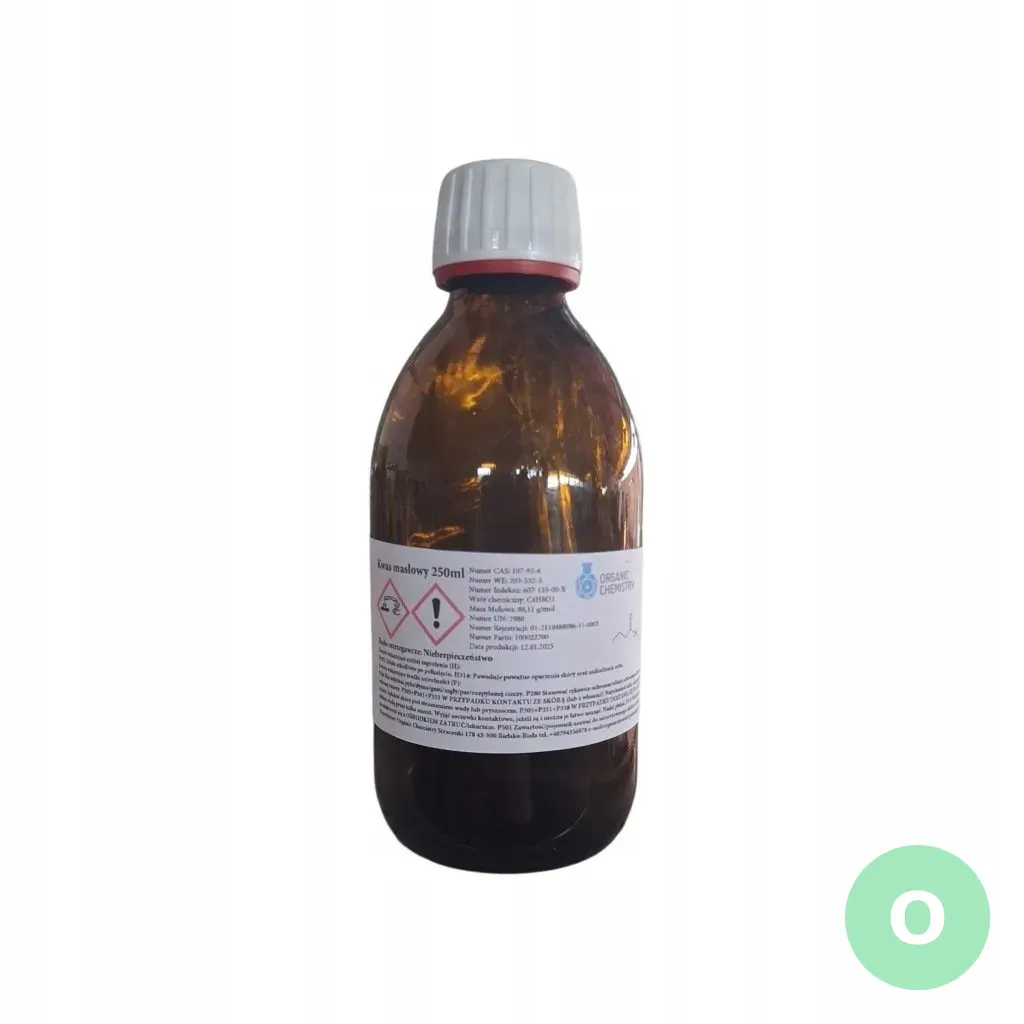
Description
Overview
- Chemical formula: C4H8O2
- CAS number: 107-92-6
- Molar mass: 88.11 g/mol
- Form: Liquid
- Purity: 99.9% (food grade)
- Other names: Butanoic acid, n-butyric acid, propylformic acid, ethylacetic acid
History and origin of the substance
Butyric acid was first discovered in 1814 by French chemist Michel Eugène Chevreul. He isolated it from butterfat. The name comes from the Greek word “butyron,” which means butter. Chevreul found this acid in rancid butter. It gave the butter its unpleasant smell.
Scientists later found butyric acid in many natural sources. It occurs in milk fat, especially in goat and sheep milk. It also forms during fermentation in the human gut. Bacteria like Clostridium butyricum produce it. This process helps break down dietary fibers.
Today, butyric acid is made synthetically for industry. Common methods include oxidation of butanol. Another method is fermentation of carbohydrates. The food grade version is highly purified. It has a minimum purity of 99.9%. This makes it suitable for precise lab work.
Applications
- Chemical synthesis: Use butyric acid to make esters for flavors and fragrances. For example, ethyl butyrate smells like pineapple. Methyl butyrate smells like apple.
- Analytical standard: Use it as a reference standard in gas chromatography. It helps calibrate instruments for fatty acid analysis. Labs use it to identify unknown samples.
- pH buffer preparation: Mix butyric acid with its salt to make a buffer solution. This buffer works well at pH 4.8. It is useful in biochemical experiments.
- Plasticizer production: Butyric acid is a raw material for cellulose butyrate. This plastic is used in coatings and films. It gives products flexibility and durability.
- Research on gut health: Scientists study butyric acid in cell cultures. It affects gene expression and cell growth. This research helps understand intestinal biology.
Specifications
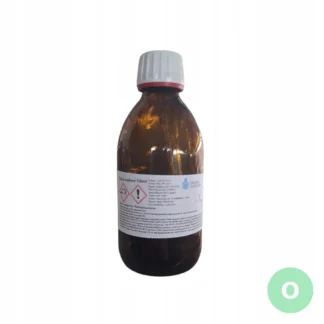
Volume: 250 ml. Weight: approximately 250 grams. Purity: 99.9% minimum. Density: 0.96 g/ml at 20°C. Boiling point: 163.5°C. Melting point: -7.9°C. Flash point: 72°C (closed cup). Solubility: miscible with water, ethanol, and ether. Storage: store in a cool, dry place. Keep away from heat and open flames. Use only in well-ventilated areas. Do not freeze. Shelf life: 24 months when stored properly.
Frequently Asked Questions
How do I use butyric acid to make a flavor ester?
To make an ester, mix butyric acid with an alcohol in a flask. Add a few drops of sulfuric acid as a catalyst. Heat the mixture gently for 30 minutes. Then cool it and add water. The ester will separate as an oily layer on top. You can smell the fruity aroma. Did you know that ethyl butyrate is used in over 100 commercial flavors?
Why does butyric acid smell so bad and is it soluble in water?
Butyric acid has a strong, rancid odor. This smell comes from its small molecular size. It easily reaches our nose receptors. The acid is fully soluble in water. It mixes in any ratio because it has a short carbon chain. Did you know that humans can detect butyric acid at just 0.001 parts per million in air?
What is the difference between food grade and technical grade butyric acid?
Food grade butyric acid has higher purity. It is 99.9% pure with very few impurities. Technical grade may be only 98-99% pure. Food grade is safer for lab work with sensitive instruments. It also has a more consistent quality. Always wear gloves and goggles when handling either grade. The strong odor can cause nausea in closed spaces.
References
- PubChem — National Library of Medicine: Comprehensive database of butyric acid properties (CID 264). Contains spectroscopic data, toxicity, and safety information. pubchem.ncbi.nlm.nih.gov
- Wikipedia EN: Overview of butyric acid synthesis, natural occurrence, and uses. en.wikipedia.org
- Safety Data Sheet (SDS): Per REACH Regulation (EC) 1907/2006 — safety, GHS classification (H302, H312, H314, H332), and labeling information.
- CLP Regulation (EC) 1272/2008: Classification as flammable liquid (Category 3), acute toxicity (Category 4), and skin corrosion (Category 1B). H302: Harmful if swallowed. H314: Causes severe skin burns.
- Journal of Chemical Education: Article on ester synthesis experiments using butyric acid. Describes safe lab procedures and reaction yields.
| Karta charakterystyki chemicznej | |
| Wzór chemiczny | C4H8O2 |
| Numer CAS | 107-92-6 |
| Numer WE (EC) / EINECS | 203-532-3 |
| Numer UN (ADR) | UN2820 |
| Masa molowa | 88.11 g/mol |
| Nazwa IUPAC (polska) | kwas butanowy |
| Nazwa IUPAC (angielska, PubChem) | butanoic acid |
| Nazwy zwyczajowe (polskie) | kwas masłowy |
| Nazwa łacińska (Farmakopea) | Acidum butyricum |
| Alternatywne nazwy IUPAC | butyric acid |
| Synonimy (międzynarodowe, PubChem) | butyric acid, butanoic acid, n-Butyric acid, n-Butanoic acid, propylformic acid, ethylacetic acid, 1-propanecarboxylic acid, Butanic acid, 1-Butyric acid, Buttersaeure |
| InChIKey | FERIUCNNQQJTOY-UHFFFAOYSA-N |
| InChI | InChI=1S/C4H8O2/c1-2-3-4(5)6/h2-3H2,1H3,(H,5,6) |
| SMILES (kanoniczny) | CCCC(=O)O |
| PubChem CID | 264 |
| Wikidata QID | Q193213 |
| Nazwa polska (Wikidata) | kwas masłowy |
| ChEMBL ID (EBI) | CHEMBL14227 |
| Barwa | oleista ciecz |
| Zapach | Unpleasant, rancid odor |
| Gęstość | 0.958 w temp. 20 °C – gęstość niższa od wody (unosi się) |
| Temperatura topnienia | -7.9 °C |
| Temperatura wrzenia | 163.5 °C w temp. 760 mmHg |
| Temperatura zapłonu | 76.7 °C |
| Temperatura samozapłonu | 450 °C |
| Prężność par | 0.43 mmHg w temp. 20 °C ; 1.4 mmHg w temp. 30 °C |
| Rozpuszczalność | ≥ 100 mg/mL w temp. 18.9 °C |
| LogP (oktanol/woda) | 0.79 |
| Współczynnik załamania | Współczynnik załamania: 1.3991 w temp. 20 °C/D |
| Lepkość | 1.426 mPa-s w temp. 25 °C |
| NFPA 704 (skala 0-4) | Zdrowie: 3 | Ogień: 2 | Reaktywność: 0 |
- ✓ PubChem (NIH/NLM)
CID 264— zweryfikowano: Wzór, CAS, IUPAC, InChI, SMILES, masa molowa, GHS - ✓ Wikidata
Q193213— zweryfikowano: wzór, masa molowa, temp. wrzenia, temp. topnienia, gęstość, nazwa polska - ✓ ChEMBL (EBI)
CHEMBL14227— zweryfikowano: InChI, SMILES, masa molowa - ✓ CAS Common Chemistry
CAS 107-92-6— zweryfikowano: oficjalny rejestr CAS Registry Number - ✓ NIST Chemistry WebBook
CAS 107-92-6— zweryfikowano: termodynamika, spektroskopia (NIST USA) - ✓ Wikipedia (EN)
CAS 107-92-6— zweryfikowano: kontekst, popularne nazwy - ✓ Wikipedia (PL)
CAS 107-92-6— zweryfikowano: polskie nazewnictwo, kontekst krajowy - ✓ ChemSpider (RSC)
CAS 107-92-6— zweryfikowano: Royal Society of Chemistry — struktura, syntezy - ✓ GESTIS Substance DB
CAS 107-92-6— zweryfikowano: BHP, toksykologia (DGUV Niemcy) - ✓ ECHA REACH/CLP Inventory
CAS 107-92-6— zweryfikowano: regulacja UE REACH/CLP, klasyfikacja - ✓ PubChem search
CAS 107-92-6— zweryfikowano: wyszukiwanie alternatywne - ✓ ChEBI (EBI)
FERIUCNNQQJTOY-UHFFFAOYSA-N— zweryfikowano: ontologie biologiczne (EBI Wielka Brytania) - ✓ Farmakopea Polska XII
Acidum butyricum— zweryfikowano: URPL — oficjalna farmakopea polska - ✓ GIS (Główny Inspektorat Sanitarny)
regulacje krajowe— zweryfikowano: polskie przepisy sanitarne, REACH wdrożenie
⚠ UWAGA — ODCZYNNIK CHEMICZNY
Butyric Acid Food Grade for Lab Use (C4H8O2) powszechnie znana jako kwas masłowy to odczynnik chemiczny przeznaczony wyłącznie do zastosowań laboratoryjnych, badawczych i profesjonalnych.
Numer CAS: 107-92-6
Numer WE (EC): 203-532-3
Numer UN (ADR): UN2820
Nazwa IUPAC: kwas butanowy
Nazwa łacińska (Farmakopea): Acidum butyricum
NIE NADAJE SIĘ DO SPOŻYCIA przez ludzi ani zwierzęta. Produkt nie jest lekiem, suplementem diety, kosmetykiem ani środkiem spożywczym. Jakiekolwiek inne zastosowanie niż laboratoryjne lub przemysłowe jest niezgodne z przeznaczeniem produktu.
Wymagane środki ochrony osobistej: rękawice ochronne, okulary lub gogle, fartuch laboratoryjny, praca w dobrze wentylowanym pomieszczeniu lub pod wyciągiem chemicznym.
Przed użyciem zapoznaj się z kartą charakterystyki substancji (SDS/MSDS) zgodnie z rozporządzeniem REACH (WE) 1907/2006 oraz CLP (WE) 1272/2008. Sprzedaż wyłącznie do celów technicznych.
Reviews
There are no reviews yet.