
Description
Overview
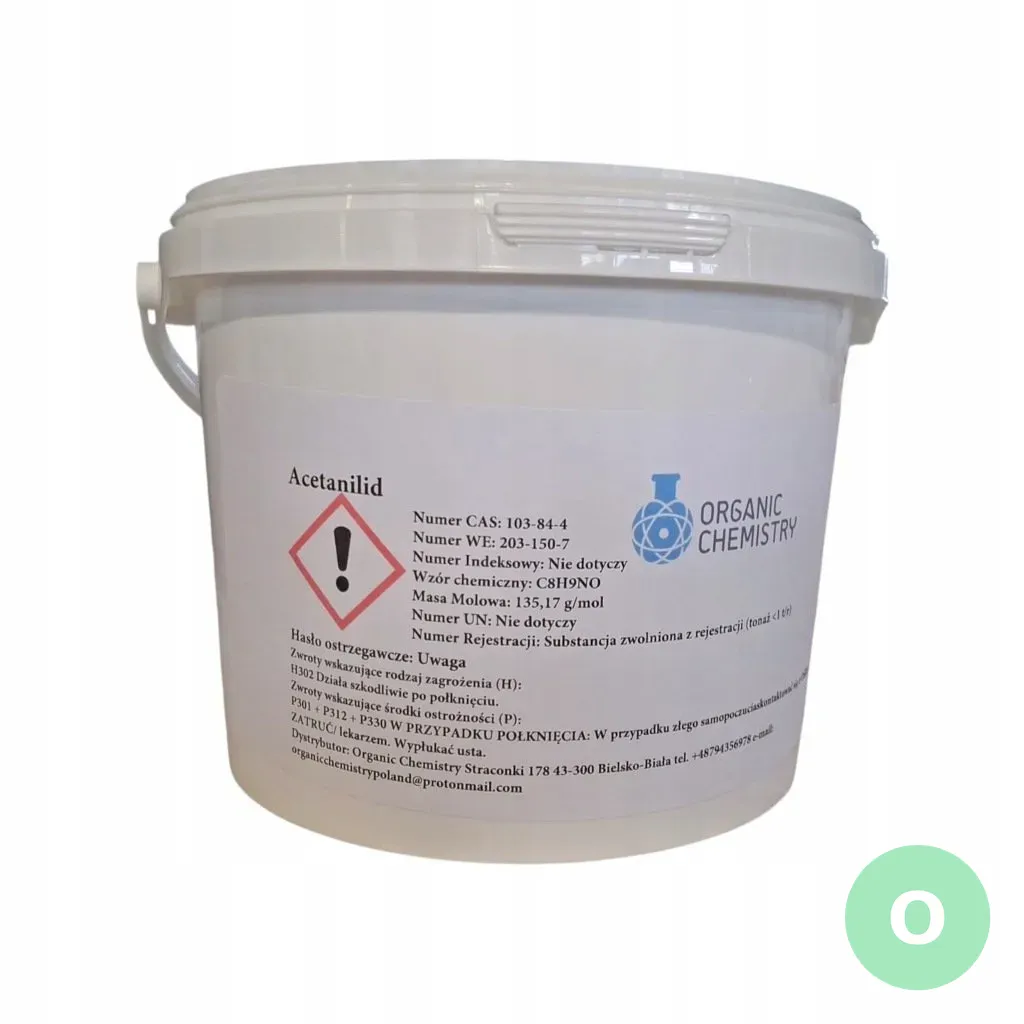
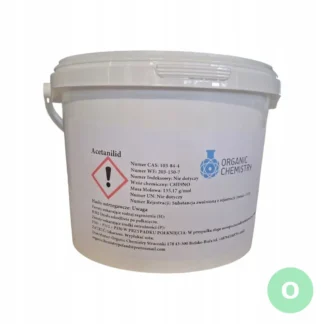
- Chemical formula: C8H9NO
- CAS number: 103-84-4
- Molar mass: 135.16 g/mol
- Form: White crystalline powder
- Purity: 99.9%
- Other names: N-phenylacetamide, Antifebrin, N-acetylaniline, acetylaniline
History and origin of the substance
Acetanilide was first synthesized in 1853 by the French chemist Charles Gerhardt. He reacted aniline with acetyl chloride to produce this new compound. At that time, chemists were looking for fever-reducing drugs. Acetanilide became one of the first synthetic antipyretics. It was sold under the brand name Antifebrin starting in 1886.
The substance was widely used in medicine for decades. However, doctors later found it caused methemoglobinemia. This condition reduces oxygen in the blood. So safer alternatives like paracetamol replaced it. Today acetanilide is no longer used as a drug. It remains important in chemical laboratories and industry.
Modern production uses acetic anhydride and aniline. The reaction is simple and gives high yields. The product is then purified by recrystallization. This process removes impurities and creates pure white crystals. The final purity of 99.9% meets analytical grade standards.
Applications
- Organic synthesis intermediate: Acetanilide is a starting material for making dyes, pharmaceuticals, and rubber chemicals. It reacts easily with other compounds to form new products.
- Analytical standard: Laboratories use it as a reference substance for calibrating instruments. Its known melting point (113-115°C) helps check thermometer accuracy.
- Peroxide stabilizer: In industry, acetanilide prevents hydrogen peroxide from decomposing too fast. It keeps the peroxide stable during storage and transport.
- Polymer additive: It works as a plasticizer or modifier in certain plastics. It improves flexibility and processing properties of polymers.
- Research reagent: Scientists use it to study chemical reactions like acetylation. It is also a model compound for testing new synthetic methods.
Specifications
Weight: 1 kg net. Form: White crystalline powder. Purity: 99.9% by GC. Melting point: 113-115°C. Boiling point: 304°C. Solubility: Slightly soluble in water (5 g/L at 25°C). Soluble in ethanol, ether, and acetone. Storage: Store in a cool, dry place below 25°C. Keep container tightly closed. Protect from light. Shelf life: 2 years when stored properly.
Frequently Asked Questions
How do I use acetanilide as a starting material for dye synthesis?
Acetanilide is first nitrated to form p-nitroacetanilide. This reaction uses a mixture of nitric and sulfuric acids at low temperature. The nitro group is then reduced to an amino group. This gives p-aminoacetanilide, which is a key intermediate for azo dyes. You can then couple it with diazonium salts to create colored compounds. Did you know that acetanilide itself is white, but its derivatives produce bright yellow, red, and blue dyes?
What are the solubility and reactivity properties of acetanilide?
Acetanilide dissolves poorly in cold water but well in hot water. It is very soluble in organic solvents like ethanol and acetone. The amide group makes it stable under normal conditions. It does not react with acids or bases at room temperature. However, strong acids can hydrolyze it to aniline and acetic acid when heated. Did you know that acetanilide’s solubility in water increases 10 times when you raise the temperature from 20°C to 100°C?
How does acetanilide differ from paracetamol in safety and chemical structure?
Acetanilide and paracetamol have similar chemical structures. Paracetamol has a hydroxyl group (-OH) on the benzene ring instead of a hydrogen atom. This small change makes paracetamol safer for human use. Acetanilide is more toxic because it forms aniline in the body. Aniline damages red blood cells. In the lab, acetanilide requires proper ventilation and gloves. Paracetamol is not used as a chemical reagent for the same reactions because its hydroxyl group interferes with some processes.
References
- PubChem — National Library of Medicine: Comprehensive database of physicochemical properties of acetanilide (CID 904). Contains spectroscopic, toxicological data, and interaction information. pubchem.ncbi.nlm.nih.gov
- Wikipedia EN: Overview of acetanilide’s history, production methods, and applications. en.wikipedia.org
- Safety Data Sheet (SDS): Per REACH Regulation (EC) 1907/2006 — safety, GHS classification (Warning, H302, H373), and substance labeling information.
- CLP Regulation (EC) 1272/2008: Classification, labeling, and packaging of chemical substances. H302: Harmful if swallowed. H373: May cause damage to blood system.
- Vogel’s Textbook of Practical Organic Chemistry: Describes synthesis and purification methods for acetanilide. Includes recrystallization techniques and yield optimization.
| Karta charakterystyki chemicznej | |
| Wzór chemiczny | C2H6 |
| Numer CAS | 74-84-0 |
| Numer WE (EC) / EINECS | 200-814-8 |
| Numer UN (ADR) | UN1961 |
| Masa molowa | 30.07 g/mol |
| Nazwa IUPAC (polska) | etan |
| Nazwa IUPAC (angielska, PubChem) | ethane |
| Nazwy zwyczajowe (polskie) | etan |
| Synonimy (międzynarodowe, PubChem) | ETHANE, Bimethyl, Dimethyl, Methylmethane, Ethyl hydride, RefChem:138120, 428-270-9, C2H6, Humulene monoxide, Humulene oxide I |
| InChIKey | OTMSDBZUPAUEDD-UHFFFAOYSA-N |
| InChI | InChI=1S/C2H6/c1-2/h1-2H3 |
| SMILES (kanoniczny) | CC |
| PubChem CID | 6324 |
| Wikidata QID | Q52858 |
| Nazwa polska (Wikidata) | etan |
| ChEMBL ID (EBI) | CHEMBL135626 |
| Barwa | bezbarwny gaz |
| Zapach | bezwonny |
| Gęstość | 0.546 w temp. -88.6 °C – gęstość niższa od wody (unosi się) |
| Temperatura topnienia | -173.3 °C |
| Temperatura wrzenia | -88.6 °C w temp. 760 mmHg |
| Temperatura zapłonu | -135 °C |
| Temperatura samozapłonu | 504.4 °C |
| Prężność par | VP: 1 Pa w temp. -183.3 °C (solid); 10 Pa w temp. -173.2 °C; 100 Pa w temp. -161.3 °C; 1 kPa w temp. -145.3 °C; 10 kPa w temp. -122.8 °C; 100 kPa w temp. -88.8 °C |
| LogP (oktanol/woda) | log Kow = 1.81 |
| Współczynnik załamania | Współczynnik załamania: 1.0377 @ 0 °C/D & 546 MM HG |
| NFPA 704 (skala 0-4) | Zdrowie: 1 | Ogień: 4 | Reaktywność: 0 |
- ✓ PubChem (NIH/NLM)
CID 6324— zweryfikowano: Wzór, CAS, IUPAC, InChI, SMILES, masa molowa, GHS - ✓ Wikidata
Q52858— zweryfikowano: wzór, masa molowa, temp. wrzenia, temp. topnienia, nazwa polska - ✓ ChEMBL (EBI)
CHEMBL135626— zweryfikowano: InChI, SMILES, masa molowa - ✓ CAS Common Chemistry
CAS 74-84-0— zweryfikowano: oficjalny rejestr CAS Registry Number - ✓ NIST Chemistry WebBook
CAS 74-84-0— zweryfikowano: termodynamika, spektroskopia (NIST USA) - ✓ Wikipedia (EN)
CAS 74-84-0— zweryfikowano: kontekst, popularne nazwy - ✓ Wikipedia (PL)
CAS 74-84-0— zweryfikowano: polskie nazewnictwo, kontekst krajowy - ✓ ChemSpider (RSC)
CAS 74-84-0— zweryfikowano: Royal Society of Chemistry — struktura, syntezy - ✓ GESTIS Substance DB
CAS 74-84-0— zweryfikowano: BHP, toksykologia (DGUV Niemcy) - ✓ ECHA REACH/CLP Inventory
CAS 74-84-0— zweryfikowano: regulacja UE REACH/CLP, klasyfikacja - ✓ PubChem search
CAS 74-84-0— zweryfikowano: wyszukiwanie alternatywne - ✓ ChEBI (EBI)
OTMSDBZUPAUEDD-UHFFFAOYSA-N— zweryfikowano: ontologie biologiczne (EBI Wielka Brytania) - ✓ GIS (Główny Inspektorat Sanitarny)
regulacje krajowe— zweryfikowano: polskie przepisy sanitarne, REACH wdrożenie
⚠ UWAGA — ODCZYNNIK CHEMICZNY
Acetanilide N Phenylacetamide Antifebrin Pure Reagent (C2H6) powszechnie znana jako etan to odczynnik chemiczny przeznaczony wyłącznie do zastosowań laboratoryjnych, badawczych i profesjonalnych.
Numer CAS: 74-84-0
Numer WE (EC): 200-814-8
Numer UN (ADR): UN1035
Nazwa IUPAC: etan
NIE NADAJE SIĘ DO SPOŻYCIA przez ludzi ani zwierzęta. Produkt nie jest lekiem, suplementem diety, kosmetykiem ani środkiem spożywczym. Jakiekolwiek inne zastosowanie niż laboratoryjne lub przemysłowe jest niezgodne z przeznaczeniem produktu.
Wymagane środki ochrony osobistej: rękawice ochronne, okulary lub gogle, fartuch laboratoryjny, praca w dobrze wentylowanym pomieszczeniu lub pod wyciągiem chemicznym.
Przed użyciem zapoznaj się z kartą charakterystyki substancji (SDS/MSDS) zgodnie z rozporządzeniem REACH (WE) 1907/2006 oraz CLP (WE) 1272/2008. Sprzedaż wyłącznie do celów technicznych.
Reviews
There are no reviews yet.