

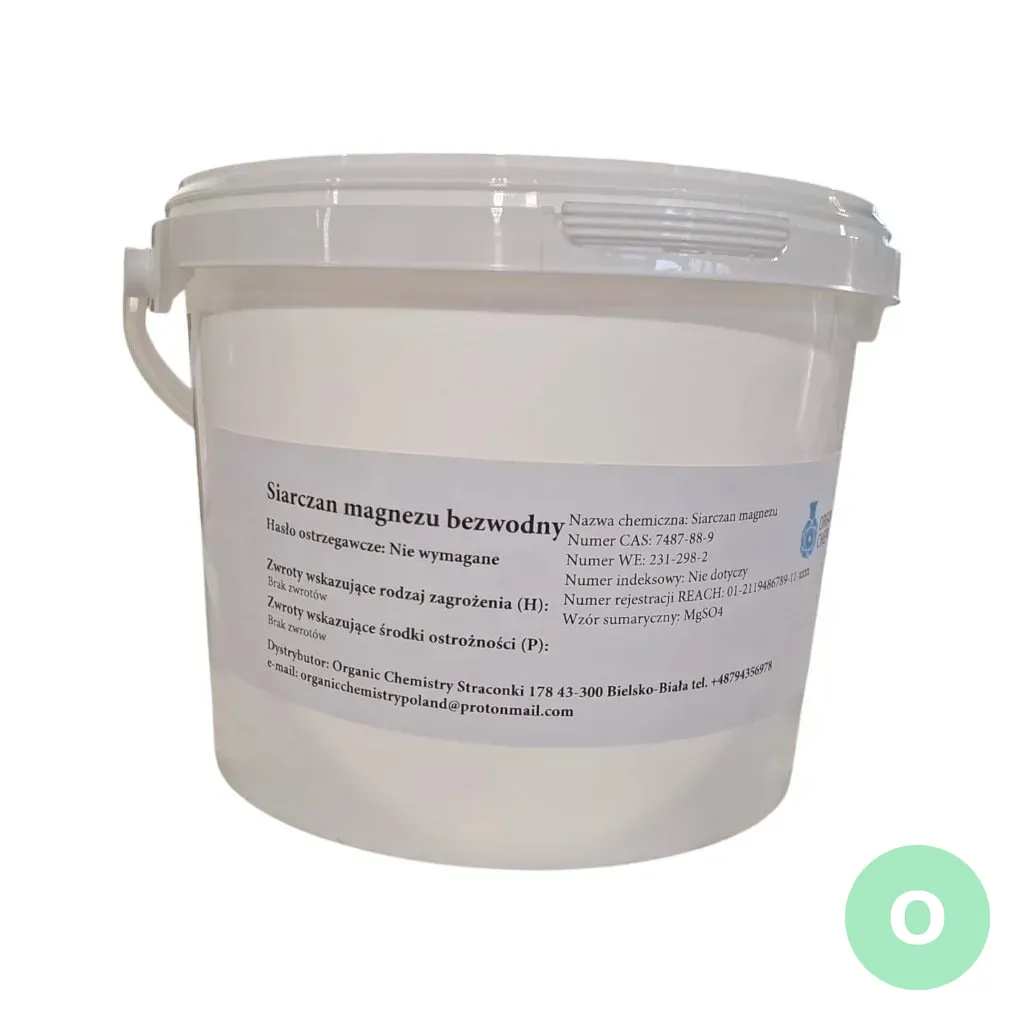
Description
Overview
- Chemical formula: MgSO4
- CAS number: 7487-88-9
- Molar mass: 120.37 g/mol
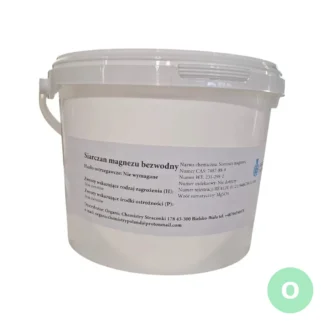
- Form: White crystalline powder
- Purity: Min 98%
- Other names: Magnesium sulfate (anhydrous), magnesium sulphate, Epsom salts (anhydrous form), MgSO4 drying agent
Applications
- Drying organic solvents: After a reaction, you often need to remove water. Add this powder to solvents like ether or dichloromethane. It binds water and can be filtered off.
- Laboratory reagent: Used in synthesis to absorb moisture from gases or liquids. It helps keep reactions dry and prevents unwanted side reactions.
- Dehydrating agent in chemical analysis: In techniques like Karl Fischer titration, it helps remove trace water. This ensures accurate measurements in analytical chemistry.
- Industrial drying of gases: In chemical plants, it dries natural gas or air. It is packed into columns and the gas flows through it.
- Agriculture as a magnesium source: In soil science, it provides magnesium for plant growth. It is used in fertilizers to correct magnesium deficiency.
Specifications
Technical parameters for this product: white crystalline powder, min 98% purity, molar mass 120.37 g/mol, CAS 7487-88-9. It is hygroscopic (absorbs water from air). Store in a tightly sealed container in a dry place below 25°C. Keep away from moisture and heat sources. Typical particle size: 0.1-0.5 mm. Bulk density approx 0.8 g/cm3. Solubility in water: 26.9 g/100 mL at 20°C. pH of 5% solution: 6.0-7.5. Not flammable. Avoid contact with eyes and skin.
Frequently Asked Questions
How do I use this powder to dry my organic solvent after a reaction?
First, separate your organic layer from water using a separatory funnel. Then add a small scoop of anhydrous magnesium sulfate to the solvent. Swirl the flask gently. You will see the powder clump together if water is present. Keep adding until the powder no longer clumps and moves freely. Then filter the solvent through a paper filter or cotton plug. The dried solvent is now ready for the next step. Did you know that magnesium sulfate can absorb up to 1.5 times its own weight in water?
Why does this powder clump when it absorbs water, and what happens to its structure?
When anhydrous magnesium sulfate absorbs water, it forms a hydrate. The chemical reaction is MgSO4 + 7H2O → MgSO4·7H2O. This hydrate has a different crystal structure. The powder grains stick together because the hydrate crystals form bridges between them. This clumping is a visual sign that the agent has worked. The process is reversible by heating the hydrate above 150°C to drive off water. Did you know that the hydrate form is the common Epsom salt used in baths?
What is the difference between this anhydrous magnesium sulfate and calcium chloride as a drying agent?
Both are drying agents, but they work differently. Magnesium sulfate is milder and does not react with many organic compounds. Calcium chloride is more aggressive and can react with alcohols, amines, and some esters. Magnesium sulfate is also easier to filter off because it forms larger crystals when hydrated. Calcium chloride can form a sticky paste. For drying sensitive compounds like esters or aldehydes, magnesium sulfate is safer. Always check compatibility with your specific chemical. Did you know that calcium chloride is also used for de-icing roads, while magnesium sulfate is not?
References
- PubChem — National Library of Medicine: Comprehensive database of physicochemical properties of magnesium sulfate (CID 24083). Contains spectroscopic, toxicological data, and interaction information. pubchem.ncbi.nlm.nih.gov
- Wikipedia EN: Overview of applications, production methods, and properties of magnesium sulfate. en.wikipedia.org
- Safety Data Sheet (SDS): Per REACH Regulation (EC) 1907/2006 — safety, GHS classification, and substance labeling information. Magnesium sulfate is not classified as hazardous under GHS.
- CLP Regulation (EC) 1272/2008: Classification, labeling, and packaging of chemical substances. Magnesium sulfate is not classified as dangerous under this regulation.
- European Pharmacopoeia: Monograph for magnesium sulfate heptahydrate, describing purity tests and assay methods relevant to pharmaceutical grade.
| Karta charakterystyki chemicznej | |
| Wzór chemiczny | C10H12FN3O4 |
| Numer CAS | 171176-43-5 |
| Numer RTECS | DB06433 |
| Masa molowa | 257.22 g/mol |
| Nazwa IUPAC (angielska, PubChem) | 4-amino-1-[(2R,3E,4S,5R)-3-(fluoromethylidene)-4-hydroxy-5-(hydroxymethyl)oxolan-2-yl]pyrimidin-2-one |
| Alternatywne nazwy IUPAC | 4-amino-1-[(2R,3E,4S,5R)-3-(fluoromethylene)-4-hydroxy-5-(hydroxymethyl)tetrahydrofuran-2-yl]pyrimidin-2-one; 4-amino-1-[(2R,3E,4S,5R)-3-(fluoromethylidene)-4-hydroxy-5-(hydroxymethyl)-2-oxolanyl]-2-pyrimidinone; 4-amino-1-[(2R,3E,4S,5R)-3-(fluoromethylidene)-4-hydroxy-5-(hydroxymethyl)oxolan-2-yl]pyrimidin-2-one |
| Synonimy (międzynarodowe, PubChem) | Tezacitabine, 2′-Deoxy-2′-(fluoromethylene)cytidine, tezacitabina, Cytidine, 2′-deoxy-2′-(fluoromethylene)-, (2E)-, tezacitabinum, MDL-101,731, RefChem:188974, Anhydrous, Cytidine, 2′-deoxy-2′-(fluoromethylene)-, monohydrate, (2’E)-, FMD-C |
| InChIKey | GFFXZLZWLOBBLO-ASKVSEFXSA-N |
| InChI | InChI=1S/C10H12FN3O4/c11-3-5-8(16)6(4-15)18-9(5)14-2-1-7(12)13-10(14)17/h1-3,6,8-9,15-16H,4H2,(H2,12,13,17)/b5-3+/t6-,8+,9-/m1/s1 |
| SMILES (kanoniczny) | C1=CN(C(=O)N=C1N)C2C(=CF)C(C(O2)CO)O |
| SMILES (izomeryczny) | C1=CN(C(=O)N=C1N)[C@H]2/C(=C/F)/[C@@H]([C@H](O2)CO)O |
| PubChem CID | 6435808 |
| Wikidata QID | Q27291019 |
| ChEMBL ID (EBI) | CHEMBL2105467 |
⚠ Masa molowa różni się: PubChem 257.22 vs Wikidata 275.092
- ✓ PubChem (NIH/NLM)
CID 6435808— zweryfikowano: Wzór, CAS, IUPAC, InChI, SMILES, masa molowa, GHS - ✓ Wikidata
Q27291019— zweryfikowano: wzór, masa molowa - ✓ ChEMBL (EBI)
CHEMBL2105467— zweryfikowano: InChI, SMILES, masa molowa - ✓ CAS Common Chemistry
CAS 171176-43-5— zweryfikowano: oficjalny rejestr CAS Registry Number - ✓ NIST Chemistry WebBook
CAS 171176-43-5— zweryfikowano: termodynamika, spektroskopia (NIST USA) - ✓ Wikipedia (EN)
CAS 171176-43-5— zweryfikowano: kontekst, popularne nazwy - ✓ Wikipedia (PL)
CAS 171176-43-5— zweryfikowano: polskie nazewnictwo, kontekst krajowy - ✓ ChemSpider (RSC)
CAS 171176-43-5— zweryfikowano: Royal Society of Chemistry — struktura, syntezy - ✓ GESTIS Substance DB
CAS 171176-43-5— zweryfikowano: BHP, toksykologia (DGUV Niemcy) - ✓ ECHA REACH/CLP Inventory
CAS 171176-43-5— zweryfikowano: regulacja UE REACH/CLP, klasyfikacja - ✓ PubChem search
CAS 171176-43-5— zweryfikowano: wyszukiwanie alternatywne - ✓ ChEBI (EBI)
GFFXZLZWLOBBLO-ASKVSEFXSA-N— zweryfikowano: ontologie biologiczne (EBI Wielka Brytania) - ✓ GIS (Główny Inspektorat Sanitarny)
regulacje krajowe— zweryfikowano: polskie przepisy sanitarne, REACH wdrożenie
⚠ UWAGA — ODCZYNNIK CHEMICZNY
Anhydrous magnesium sulfate min for drying (C10H12FN3O4) to odczynnik chemiczny przeznaczony wyłącznie do zastosowań laboratoryjnych, badawczych i profesjonalnych.
Numer CAS: 171176-43-5
NIE NADAJE SIĘ DO SPOŻYCIA przez ludzi ani zwierzęta. Produkt nie jest lekiem, suplementem diety, kosmetykiem ani środkiem spożywczym. Jakiekolwiek inne zastosowanie niż laboratoryjne lub przemysłowe jest niezgodne z przeznaczeniem produktu.
Wymagane środki ochrony osobistej: rękawice ochronne, okulary lub gogle, fartuch laboratoryjny, praca w dobrze wentylowanym pomieszczeniu lub pod wyciągiem chemicznym.
Przed użyciem zapoznaj się z kartą charakterystyki substancji (SDS/MSDS) zgodnie z rozporządzeniem REACH (WE) 1907/2006 oraz CLP (WE) 1272/2008. Sprzedaż wyłącznie do celów technicznych.
Reviews
There are no reviews yet.