
Description
Overview
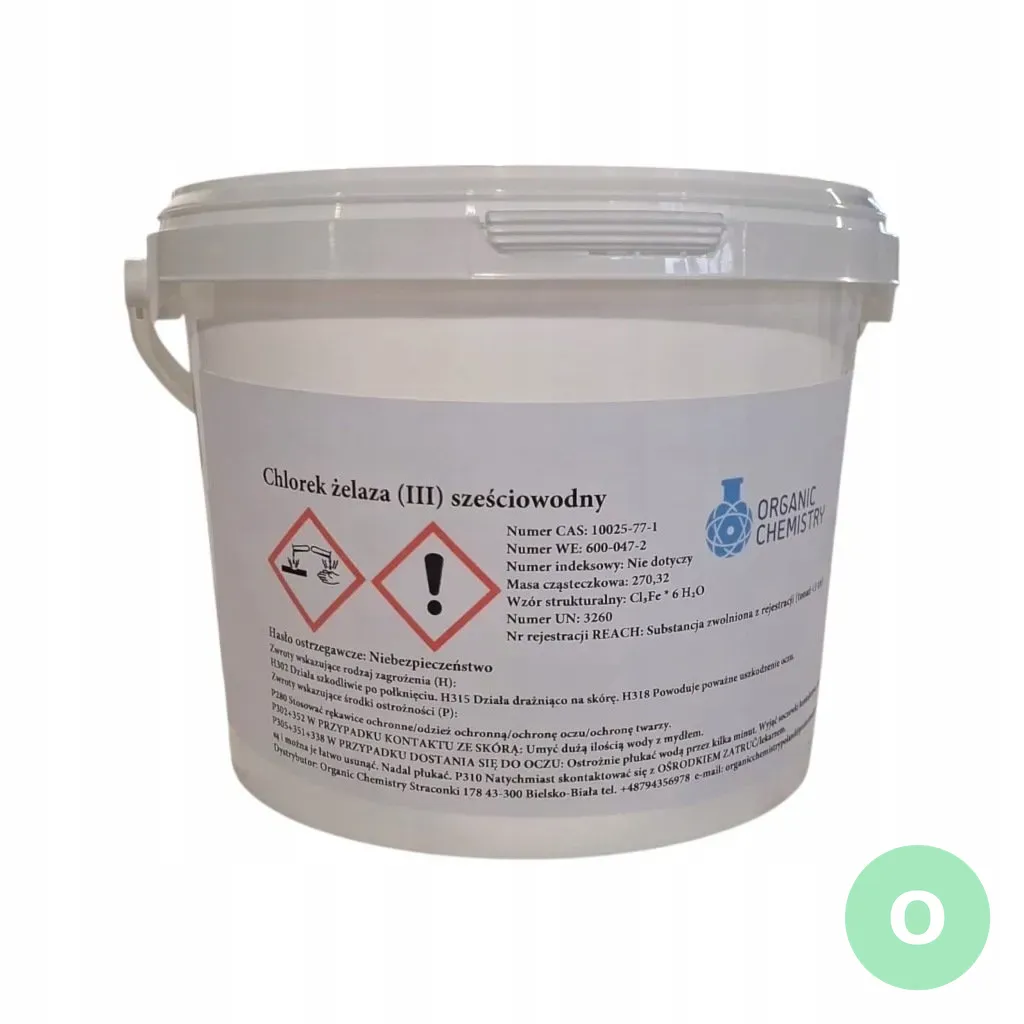
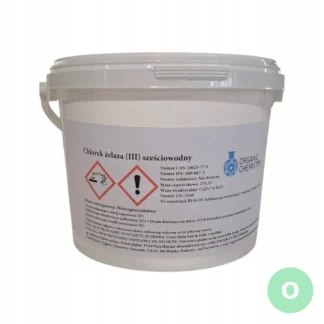
- Chemical formula: FeCl3·6H2O
- CAS number: 10025-77-1
- Molar mass: 270.30 g/mol
- Form: crystals
- Purity: ≥ 99%
- Other names: Iron(III) chloride hexahydrate, ferric chloride hexahydrate, iron trichloride hexahydrate
History and origin of the substance
Iron(III) chloride was first made in the 18th century. Chemists discovered it by dissolving iron in hydrochloric acid. Then they added chlorine gas to the solution. This created the yellow-brown crystals we know today.
In the 19th century, its use grew fast. It became a key chemical for etching copper plates. Printers used it to make detailed images. Later, water treatment plants adopted it for cleaning drinking water.
Today, iron(III) chloride hexahydrate is a common lab chemical. It is also used in industry for many tasks. Its ability to react with metals and organic compounds makes it very versatile.
Applications
- Copper etching: It dissolves copper metal quickly. This is used to make printed circuit boards (PCBs). The process is fast and precise.
- Water treatment: It helps remove dirt and particles from water. The iron ions bind to impurities and make them sink. This cleans the water for drinking.
- Catalyst in organic chemistry: It speeds up certain chemical reactions. For example, it helps make chlorinated compounds. This saves time and energy in labs.
- Pigment production: It is used to make iron oxide pigments. These pigments give color to paints, plastics, and ceramics. The colors are often yellow, red, or brown.
- Analytical chemistry: It is a reagent to test for other chemicals. For instance, it detects phenols in a sample. The test gives a purple color if phenols are present.
Specifications
Form: yellow-brown deliquescent crystals. Molar mass: 270.30 g/mol. Purity: ≥ 99%. Solubility: very soluble in water (about 900 g/L at 20°C). pH of 1% solution: about 2.0 (acidic). Storage: keep in a dry, cool place. Seal container tightly after use. Avoid contact with moisture and air.
Frequently Asked Questions
How do I use this product to etch copper for PCBs?
First, dissolve the crystals in water. A common mix is 1 part FeCl3·6H2O to 3 parts water. Heat the solution to about 40-50°C for faster etching. Dip the copper board into the liquid. Stir gently to remove waste. The copper dissolves in 5-15 minutes. Rinse the board with water after etching. Did you know that the reaction turns the solution green as copper(II) chloride forms?
Why does this chemical dissolve so well in water?
Iron(III) chloride hexahydrate has a high solubility because of its ionic structure. The iron and chloride ions separate easily in water. The water molecules also surround each ion. This process releases heat, so the solution gets warm. The hexahydrate form already has water inside its crystals. This makes it dissolve even faster than the anhydrous form. Did you know that a saturated solution at 20°C contains about 900 grams of FeCl3·6H2O per liter of water?
How is this different from anhydrous iron(III) chloride?
The hexahydrate has six water molecules attached. Anhydrous FeCl3 has none. This makes the hexahydrate less reactive with water. It also makes it safer to handle. Anhydrous FeCl3 reacts violently with water and can cause burns. The hexahydrate is also easier to store because it does not absorb moisture as fast. However, for some reactions, the anhydrous form is needed to avoid water. Always check your lab procedure before choosing which form to use.
References
- PubChem — National Library of Medicine: Comprehensive database of physicochemical properties of iron(III) chloride hexahydrate (CID 24813). Contains spectroscopic, toxicological data, and interaction information. pubchem.ncbi.nlm.nih.gov
- Wikipedia EN: Overview of applications, production methods, and properties of iron(III) chloride. en.wikipedia.org
- Safety Data Sheet (SDS): Per REACH Regulation (EC) 1907/2006 — safety, GHS classification, and substance labeling information. Available from chemical suppliers.
- CLP Regulation (EC) 1272/2008: Classification, labeling, and packaging of chemical substances. H302 (Harmful if swallowed), H314 (Causes severe skin burns and eye damage), H335 (May cause respiratory irritation).
| Karta charakterystyki chemicznej | |
| Wzór chemiczny | Fe |
| Numer CAS | 7439-89-6 |
| Numer WE (EC) / EINECS | 231-096-4 |
| Numer RTECS | DB01592 |
| Masa molowa | 55.84 g/mol |
| Nazwa IUPAC (angielska, PubChem) | iron |
| Synonimy (międzynarodowe, PubChem) | IRON, Iron powder, Iron, elemental, ferrous iron, Remko, iron metal, Armco iron, Ferrovac E, Hoeganaes EH, 3ZhP |
| InChIKey | XEEYBQQBJWHFJM-UHFFFAOYSA-N |
| InChI | InChI=1S/Fe |
| SMILES (kanoniczny) | [Fe] |
| PubChem CID | 23925 |
| Wikidata QID | Q677 |
| Nazwa polska (Wikidata) | żelazo |
| Gęstość | 7.87 g/cu cm |
| Temperatura topnienia | 1538 °C |
| Temperatura wrzenia | 2,861 °C |
| Prężność par | 1Pa w temp. 1455 °C (solid); 10 Pa w temp. 1617 °C; 100 Pa w temp. 1818 °C; 1 kPa w temp. 2073 °C; 10 kPa w temp. 2406 °C; 100 kPa w temp. 2859 °C |
- ✓ PubChem (NIH/NLM)
CID 23925— zweryfikowano: Wzór, CAS, IUPAC, InChI, SMILES, masa molowa, GHS - ✓ Wikidata
Q677— zweryfikowano: wzór, masa molowa, temp. wrzenia, temp. topnienia, gęstość, nazwa polska - ✓ CAS Common Chemistry
CAS 7439-89-6— zweryfikowano: oficjalny rejestr CAS Registry Number - ✓ NIST Chemistry WebBook
CAS 7439-89-6— zweryfikowano: termodynamika, spektroskopia (NIST USA) - ✓ Wikipedia (EN)
CAS 7439-89-6— zweryfikowano: kontekst, popularne nazwy - ✓ Wikipedia (PL)
CAS 7439-89-6— zweryfikowano: polskie nazewnictwo, kontekst krajowy - ✓ ChemSpider (RSC)
CAS 7439-89-6— zweryfikowano: Royal Society of Chemistry — struktura, syntezy - ✓ GESTIS Substance DB
CAS 7439-89-6— zweryfikowano: BHP, toksykologia (DGUV Niemcy) - ✓ ECHA REACH/CLP Inventory
CAS 7439-89-6— zweryfikowano: regulacja UE REACH/CLP, klasyfikacja - ✓ PubChem search
CAS 7439-89-6— zweryfikowano: wyszukiwanie alternatywne - ✓ ChEBI (EBI)
XEEYBQQBJWHFJM-UHFFFAOYSA-N— zweryfikowano: ontologie biologiczne (EBI Wielka Brytania) - ✓ GIS (Główny Inspektorat Sanitarny)
regulacje krajowe— zweryfikowano: polskie przepisy sanitarne, REACH wdrożenie
⚠ UWAGA — ODCZYNNIK CHEMICZNY
Iron(III) chloride hexahydrate technical reagent (Fe) to odczynnik chemiczny przeznaczony wyłącznie do zastosowań laboratoryjnych, badawczych i profesjonalnych.
Numer CAS: 7439-89-6
NIE NADAJE SIĘ DO SPOŻYCIA przez ludzi ani zwierzęta. Produkt nie jest lekiem, suplementem diety, kosmetykiem ani środkiem spożywczym. Jakiekolwiek inne zastosowanie niż laboratoryjne lub przemysłowe jest niezgodne z przeznaczeniem produktu.
Wymagane środki ochrony osobistej: rękawice ochronne, okulary lub gogle, fartuch laboratoryjny, praca w dobrze wentylowanym pomieszczeniu lub pod wyciągiem chemicznym.
Przed użyciem zapoznaj się z kartą charakterystyki substancji (SDS/MSDS) zgodnie z rozporządzeniem REACH (WE) 1907/2006 oraz CLP (WE) 1272/2008. Sprzedaż wyłącznie do celów technicznych.
Reviews
There are no reviews yet.