
Description
Overview
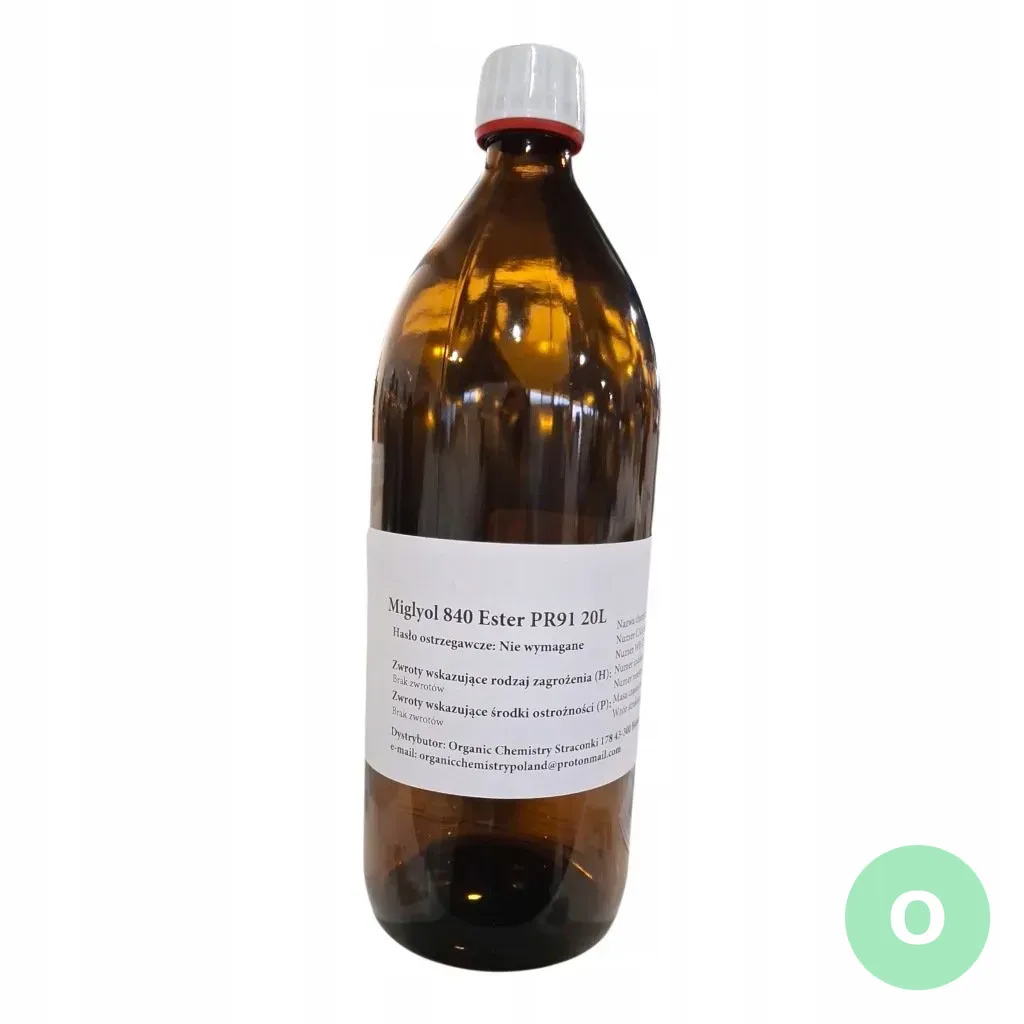
- Chemical formula: C9H18O2 (main component: caprylic/capric triglyceride)
- CAS number: 73398-61-5 (mixture)
- Molar mass: ~470 g/mol (average)
- Form: liquid
- Purity: 99.9%
- Other names: Medium-chain triglycerides (MCT), caprylic/capric triglyceride, fractionated coconut oil
History and origin of the substance
Miglyol 840 belongs to the family of medium-chain triglycerides (MCTs). These oils were first developed in the 1950s by German chemists. They wanted to create a stable, non-oxidizing fat for medical and technical uses. The process involves hydrolyzing coconut or palm kernel oil. Then the medium-chain fatty acids (C8 and C10) are separated and re-esterified with glycerol.
The name “Miglyol” comes from a brand of fractionated coconut oil. It is produced by BASF (formerly by Dynamit Nobel). The number 840 refers to a specific grade with a defined chain length distribution. This grade is popular in labs because it is very pure and has low viscosity. It does not go rancid like regular vegetable oils.
Today, Miglyol 840 is a standard reagent in many industries. It is used in cosmetics, pharmaceuticals, and chemical synthesis. Its chemical stability and solvent power make it valuable for dissolving lipophilic compounds. It is also a common carrier for active ingredients in research.
Applications
- Solvent for lipophilic compounds: Dissolves oils, waxes, and fat-soluble vitamins in laboratory formulations. Works well for preparing standards and calibration solutions.
- Lubricant in mechanical testing: Used as a low-viscosity lubricant for precision instruments and pumps. Reduces friction without leaving sticky residues.
- Carrier for active ingredients: Mixes with active pharmaceutical ingredients (APIs) for stability studies. Does not react with most compounds.
- Emulsifier base: Creates stable oil-in-water emulsions in cosmetic and industrial recipes. Helps blend water and oil phases.
- Cleaning agent for residues: Removes sticky organic residues from glassware and equipment. Works better than harsh solvents for some greases.
Specifications
Technical parameters: Density 0.94-0.96 g/mL at 20°C. Viscosity 25-33 mPa·s at 20°C. Refractive index 1.448-1.452. Acid value <0.1 mg KOH/g. Iodine value <1.0 g I2/100g. Water content <0.1%. Storage conditions: Store in a cool, dry place away from direct sunlight. Keep container tightly closed. Do not freeze. Shelf life: 2 years from production date. Volume: 1 liter (nominal). Weight: approximately 0.95 kg per liter.
Frequently Asked Questions
Can I use Miglyol 840 as a solvent for essential oils in lab experiments?
Yes, Miglyol 840 is an excellent solvent for essential oils and other lipophilic substances. It dissolves oils like peppermint, lavender, and eucalyptus easily. The mixture stays clear and stable. You can use it to prepare standard solutions for gas chromatography or spectrophotometry. It does not evaporate quickly, so it is good for long-term storage.
Does Miglyol 840 oxidize or become rancid over time?
No, Miglyol 840 is very resistant to oxidation. It has a very low iodine value (<1.0), meaning it has almost no unsaturated bonds. This prevents it from reacting with oxygen in the air. Did you know that regular vegetable oils can go rancid in weeks, but Miglyol 840 stays stable for years under proper storage? It does not form peroxides or off-flavors.
What is the difference between Miglyol 840 and regular coconut oil for lab use?
Miglyol 840 is fractionated and highly purified. Regular coconut oil contains long-chain fatty acids and natural impurities. Miglyol 840 has a defined composition (mainly C8 and C10 chains). It is liquid at room temperature, while coconut oil is solid below 24°C. For lab work, Miglyol 840 gives more consistent results. It also has lower viscosity and better thermal stability. Safety: Always wear gloves and goggles when handling. It is not flammable but can irritate eyes.
References
- PubChem — National Library of Medicine: Comprehensive database of physicochemical properties of medium-chain triglycerides (CID 11005 for caprylic triglyceride). Contains spectroscopic data, solubility, and safety information. pubchem.ncbi.nlm.nih.gov
- Wikipedia EN: Overview of medium-chain triglycerides, their production, and applications in chemistry and industry. en.wikipedia.org
- Safety Data Sheet (SDS) for Miglyol 840: Per REACH Regulation (EC) 1907/2006 — safety, GHS classification (not classified as hazardous), and handling instructions. Available from supplier.
- CLP Regulation (EC) 1272/2008: Classification, labeling, and packaging of chemical substances. Miglyol 840 is not classified as hazardous under CLP. No H/P numbers apply.
- European Pharmacopoeia (Ph. Eur.): Monograph for medium-chain triglycerides (MCT) used as excipients. Provides purity standards and testing methods.
| Karta charakterystyki chemicznej | |
| Wzór chemiczny | C39H80O10 |
| Numer CAS | 77466-09-2 |
| Masa molowa | 709.0 g/mol |
| Nazwa IUPAC (angielska, PubChem) | bis(decanoic acid);bis(octanoic acid);propane-1,2-diol |
| Alternatywne nazwy IUPAC | capric acid;caprylic acid;propane-1,2-diol |
| Synonimy (międzynarodowe, PubChem) | Miglyol 840, Miglyol-840, migliol 840, Propylene glycol, dicaprylate, dicaprate, RefChem:925884, PWEOPMBMTXREGV-UHFFFAOYSA-N |
| InChIKey | PWEOPMBMTXREGV-UHFFFAOYSA-N |
| InChI | InChI=1S/2C10H20O2.2C8H16O2.C3H8O2/c2*1-2-3-4-5-6-7-8-9-10(11)12;2*1-2-3-4-5-6-7-8(9)10;1-3(5)2-4/h2*2-9H2,1H3,(H,11,12);2*2-7H2,1H3,(H,9,10);3-5H,2H2,1H3 |
| SMILES (kanoniczny) | CCCCCCCCCC(=O)O.CCCCCCCCCC(=O)O.CCCCCCCC(=O)O.CCCCCCCC(=O)O.CC(CO)O |
| PubChem CID | 53471835 |
- ✓ PubChem (NIH/NLM)
CID 53471835— zweryfikowano: Wzór, CAS, IUPAC, InChI, SMILES, masa molowa, GHS - ✓ CAS Common Chemistry
CAS 77466-09-2— zweryfikowano: oficjalny rejestr CAS Registry Number - ✓ NIST Chemistry WebBook
CAS 77466-09-2— zweryfikowano: termodynamika, spektroskopia (NIST USA) - ✓ Wikipedia (EN)
CAS 77466-09-2— zweryfikowano: kontekst, popularne nazwy - ✓ Wikipedia (PL)
CAS 77466-09-2— zweryfikowano: polskie nazewnictwo, kontekst krajowy - ✓ ChemSpider (RSC)
CAS 77466-09-2— zweryfikowano: Royal Society of Chemistry — struktura, syntezy - ✓ GESTIS Substance DB
CAS 77466-09-2— zweryfikowano: BHP, toksykologia (DGUV Niemcy) - ✓ ECHA REACH/CLP Inventory
CAS 77466-09-2— zweryfikowano: regulacja UE REACH/CLP, klasyfikacja - ✓ PubChem search
CAS 77466-09-2— zweryfikowano: wyszukiwanie alternatywne - ✓ ChEBI (EBI)
PWEOPMBMTXREGV-UHFFFAOYSA-N— zweryfikowano: ontologie biologiczne (EBI Wielka Brytania) - ✓ GIS (Główny Inspektorat Sanitarny)
regulacje krajowe— zweryfikowano: polskie przepisy sanitarne, REACH wdrożenie
⚠ UWAGA — ODCZYNNIK CHEMICZNY
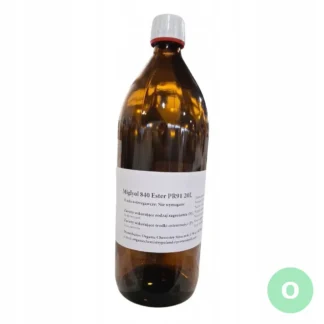
Miglyol 840 and Miglyol Technical Reagent Overview (C39H80O10) to odczynnik chemiczny przeznaczony wyłącznie do zastosowań laboratoryjnych, badawczych i profesjonalnych.
Numer CAS: 77466-09-2
NIE NADAJE SIĘ DO SPOŻYCIA przez ludzi ani zwierzęta. Produkt nie jest lekiem, suplementem diety, kosmetykiem ani środkiem spożywczym. Jakiekolwiek inne zastosowanie niż laboratoryjne lub przemysłowe jest niezgodne z przeznaczeniem produktu.
Wymagane środki ochrony osobistej: rękawice ochronne, okulary lub gogle, fartuch laboratoryjny, praca w dobrze wentylowanym pomieszczeniu lub pod wyciągiem chemicznym.
Przed użyciem zapoznaj się z kartą charakterystyki substancji (SDS/MSDS) zgodnie z rozporządzeniem REACH (WE) 1907/2006 oraz CLP (WE) 1272/2008. Sprzedaż wyłącznie do celów technicznych.
Reviews
There are no reviews yet.